PART Five
Sustainment
“Tactics are the art of the logistically feasible”
- Anonomous
“Amateurs talk Tactics. Professionals talk Logistics”
- Anonomous
Sustainment
Any consideration of the demands of Sustainment in Littoral Operations must include a definition of its breadth and limitations.
In short, military sustainment includes supply of key commodities (ammunition, food, fuel, water, equipment); maintenance and repair
of key equipment and capabilities; transportation and movement of both men and materiel; and medical and health support. Other tasks may fall under this banner (i.e., facilities and services) but will not be considered here. A reminder – the Normandy Landings were largely characterised by mass and demanded the development of the ‘iron mountain’: daily landing multiple thousands of tons of stores and moving them through large logistics bases to enable sustainment functions to be pushed forward to support combat divisions. It is also worth highlighting the assumption that an undertaking of the scale and ambition of Operation Overlord is unlikely to occur again and so a reproduction of the logistic requirement in the modern setting is therefore remote. In the region of 160,000 men landed on D-Day from the sea and the air. All required sustainment, so the logistic burden was immense. That said, the ‘lines of communication’ were relatively short – from Southern England to the Northwest Coast of France. But it is also worthy of note that the USMC, in their quest to deploy multiple small teams dispersed across the battle
space, identify their ‘pacing challenge’ today as one of sustainment. And, that sustainment may have to be conducted over many hundreds if not thousands of miles.
Supply.
Military planners in 1944 wanted to secure a port as quickly as possible. Given that this would have been obvious to the German defenders, the ports along the Atlantic/Channel coastlines were both heavily defended and badly damaged (as a consequence of both Allied and German activity). Because of this, and given the enormous scale of the undertaking, a number of radical decisions were taken. The first was that two artificial harbours (Mulberries) were prefabricated in Britain and towed to the French coast where they were assembled to create the means for rapid bulk supply.
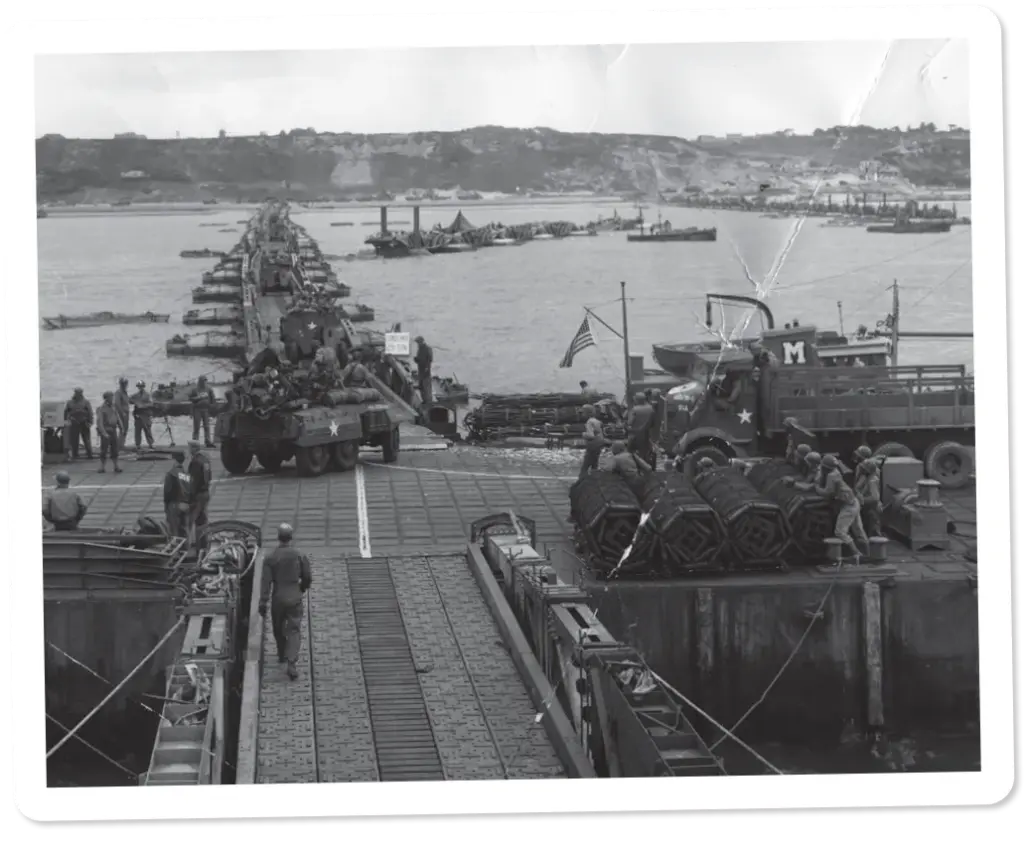
The second decision was the construction of a ‘Pipeline Under the Ocean’ (or PLUTO) which operated from Oct 1944-Aug 1945, pumping fuel from Southern England into Le Havre in France. Although dwarfed by the delivery of fuel by tankers, the ambition to deliver fuel in this fashion was impressive and reflects the nature and scale of the challenge. Combat supplies (food, ammunition) were moved by Ordnance Companies into pre–planned dumps from which supplies could be pushed forward. This would include key combat capabilities such as bridging equipment which could not be held too far forward but had to be ready to be pushed quickly into action when required.
Comparison with today
The contemporary challenge is similar insofar as it involves the movement of key commodities and functions over distance into a (potentially) high-risk theatre. However, 1944’s practices would be mostly redundant for the likely operations of today, where the sustainment of small, dispersed teams in an adversary AA/AD zone is likely to be both hazardous and highly complex.
Maintenance and Repair.
Along with supply of key equipment, spares and components, equipment requires maintenance and repair – particularly in forward areas. This was certainly the case in 1944 where a huge number of weapons (and their associated ammunition) radios, craft, vehicles and aircraft along with a wide array of specialist kit was operated by the landing forces. Not all the equipment was standardised and whilst there was some commonality, national lines were inevitably drawn, causing inefficiencies. Usually, repair parties would be located well forward with mechanics and maintainers commonly operating immediately behind the front line (and sometimes beyond it when recovering key equipment damaged in combat). This is particularly relevant given the requirement to maintain momentum and to keep high-value equipment in the fight.
Comparison with today
Given modern doctrine, the repair and maintenance function forward is likely to be minimal and quite possibly limited to covering highly specialised vital equipment such as secure comms. Repair and maintenance are more than likely to be switched to ‘replacement’, as attritable or lightweight systems are probably easier to replace than to repair.
Transportation and Movement.
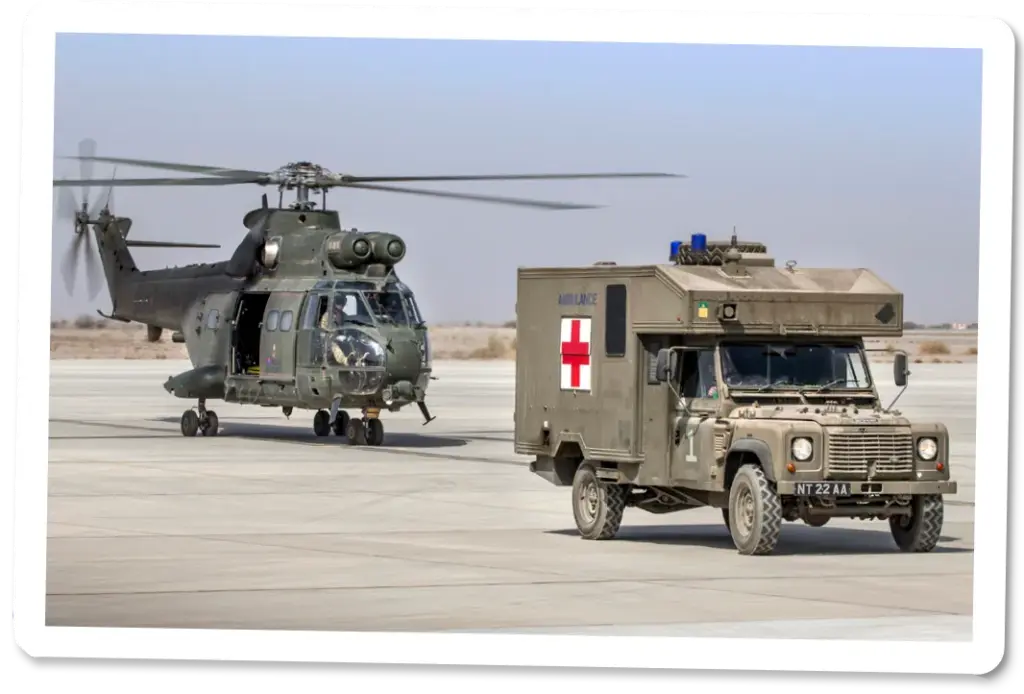
Transport and Movement in the logistic sense is not to be confused with Tactical Mobility, although in 1944 the two were often blurred. The former is not generally undertaken in contact whilst the latter is a function of manoeuvre and is generally undertaken when in close proximity and in contact with the enemy. In the main, transport and movement assets provide the lift for combat supplies, replacement equipment and specialist equipment (i.e., bridging) moving forward whilst recovering damaged equipment to the rear for repair. The ‘Red Ball Express’ is a good example – a huge US Army road convoy system that pushed supplies forward to support divisions in combat and thus maintain operational tempo. During the Ardennes offensive in 1944 an entire division (101st Airborne) was moved by these vehicles to reinforce the besieged town of Bastogne. But movement of any sort presents a significant challenge within an adversary AA/AD zone and thus logistic replenishment is likely to be conducted by manned and unmanned air, surface and sub-surface vessels and possibly in very limited form by road when tactical circumstances permit.
Comparison with today
In today’s climate, unmanned systems are likely to form a large proportion of transport and movement assets in support of a littoral force and, whilst there is frequent discussion concerning the limited capacity of unmanned aerial systems, uncrewed surface and sub-surface vessels offer significant possibilities.
Medical and Health Support.
The development of military medicine and health care has grown over time and, post the carnage of the First World War, significant effort was expended to avoid the doctrine and tactics that would lead to any repeat of the industrial slaughter experienced in 1914-18 – see previous comments about ‘steel not flesh’. Significant casualties were anticipated in the planning for Operation Overlord in 1944 and whilst they were not fully realised, there were (and remain) an inevitable consequence of conflict. Front line Aid Posts triaged casualties and carried out emergency treatment before moving the wounded rearwards, initially to Dressing Stations and thence possibly to Field Hospitals. But Second World War casualties were still high in comparison to the conflicts that followed. In the major post-war conflicts (Korea and Vietnam) and in the many, limited, ‘brush fire’ wars that characterised the 1960s, the same medical support system endured as had been employed in Normandy, standfast the introduction of dedicated casualty-evacuation (CASEVAC) helicopters.
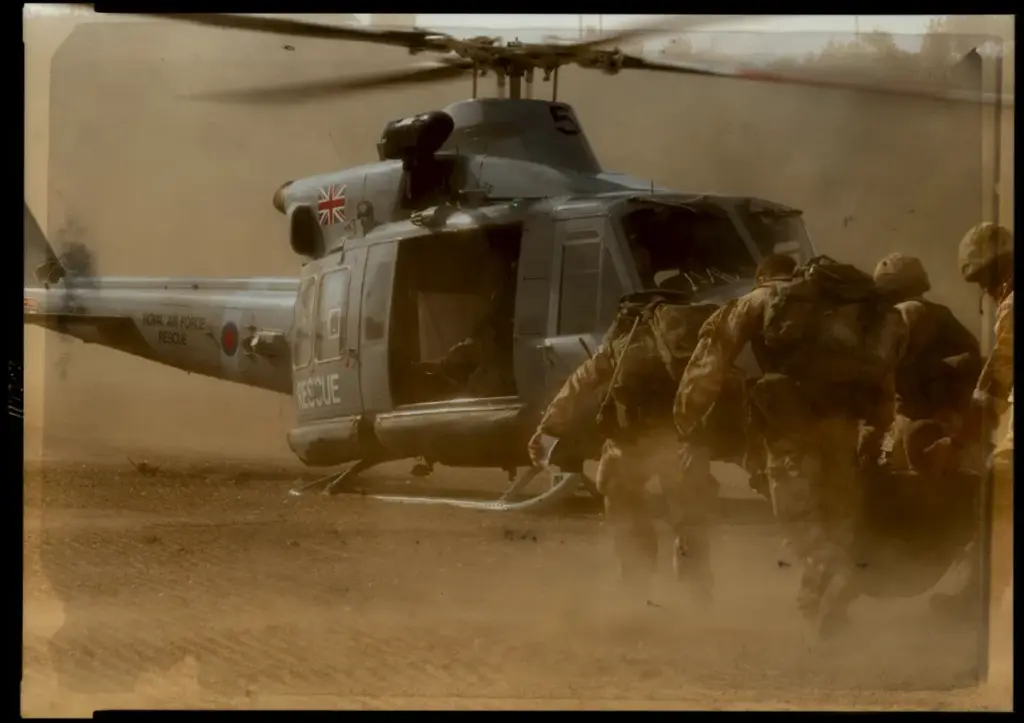
But by the latter part of the 20th Century and into the 21st Century, nation states began to recognise more closely the negative political effect of casualties and so steps were taken both to reduce the risk of death or serious injury and to improve treatment. It is fair to say that the conflicts in both Iraq and Afghanistan saw men survive wounding that simply would never have done so in previous campaigns. In particular, the ‘golden hour’ of achieving evacuation of casualties, often by specialist aircraft with embarked surgery specialists within an hour of wounding, became the norm.
Comparison with today
The challenge for the commanders and planners of today’s littoral operations is to attempt to live up to the demands of the ‘golden hour’ and to manage political expectations accordingly. Small teams of disaggregated specialist troops, distributed across an area of operations may be prone to incurring fewer casualties and may have advanced first aid capabilities deployed forward. However, dealing effectively and quickly with casualties under such conditions will undoubtedly pose a testing challenge. Exploiting the full array of remote and autonomous systems, particularly unmanned surface craft and submersibles is likely to feature as a part of any solution to the sustainment challenge.
The Future
The prosecution of future operations is likely to be very different to that of 1944, as technology continues to advance and geo–political conditions wax and wane. But, against that backdrop, combat development will certainly continue to influence change. This is already evident across the globe as nations attempt to reform their militaries in order to adapt to new norms and to take account of and exploit change. Technological advances in weaponry, coupled with the digital revolution and the increasing power and utility of Artificial Intelligence paint a dazzling picture of future conflict and any future operation in the littoral is likely to be characterised by many (if not all) of the factors described in this paper: capable adversaries with access to cheap and abundant sensors linked to capable strike systems. These peer–level capabilities also seek to by–pass traditional Western strengths and so compel a shift in approach. The requirement for urgent change has been firmly seized and investment in an array of new systems, not least in the unmanned area is broadly evident, influenced by the lessons emerging from Ukraine. The forthcoming introduction of medium displacement uncrewed surface vessels (MDUSVs), in the USA and the initial flight of the Proteus full scale unmanned rotary wing aircraft in UK are good illustrations but are but two elements of a vast programme which will see the nature of conflict in the littoral evolve. The ongoing adaptation of people, formations, systems and processes to reflect the new challenge is compelling although there remains significant scope for acceleration of change across the board. New doctrines and concepts will see force being applied in different ways and using a vast array of complex new means however, it is quite likely that objectives may remain familiar.
It was obvious to the Western Allies in 1944 that Germany and Japan would have to be defeated in detail, not least because of the imposition of unconditional surrender as a condition for the Axis. To achieve such ends would require the employment of the full weight of national power, not least the commitment of vast numbers of (mainly) men to the task. The requirement for mass was possibly never better illustrated than by the Allied invasion of France in 1944, spearheaded by Operation Overlord. The likelihood of conflict on a similar scale to that witnessed in 1944 is probably limited (but not impossible) and force projection at varying scales is still a valuable military option but will likely be employed in a different form to that in 1944. Mass will be replaced by a more refined application of small packets of highly capable combat power projected at range into the adversary’s zone of influence without being sensed.
The influence of technology means that adversaries will operate differently, so Allied responses must reflect that by avoiding opposition strength and leveraging the full panoply of systems available by deploying small, agile and highly trained teams in a dispersed fashion across the area of operations, able to bring combat power to bear using organic and remote manned and unmanned systems.
These will range from submersible craft capable of operating with relative impunity within an adversary’s Weapons Engagement Zone (WEZ) and likely in an Anti–Access and Area–Denial (AA/AD) environment, through to multiples of small, lightweight air systems that can confuse or overmatch an adversary air defence system and thus change the risk/threat balance. Adding the potential benefits of Artificial Intelligence in the development and operation of equipment and in the prosecution of operations could also yield significant advantages. Operating as a part of a secure, integrated, networked framework, this gives today’s commanders with an array of options and will allow force to be applied in support of Allied objectives. This will require small, agile, highly trained teams, deployed at range and able to conduct an array of tasks. This could be undertaken across the spectrum of conflict from limited ‘Grey Zone’ or ‘Hybrid’ operations through to high intensity combat in high risk/high threat conditions and involving the full spread of offensive capabilities. Technology has and will continue to shape the way that littoral operations are conducted.
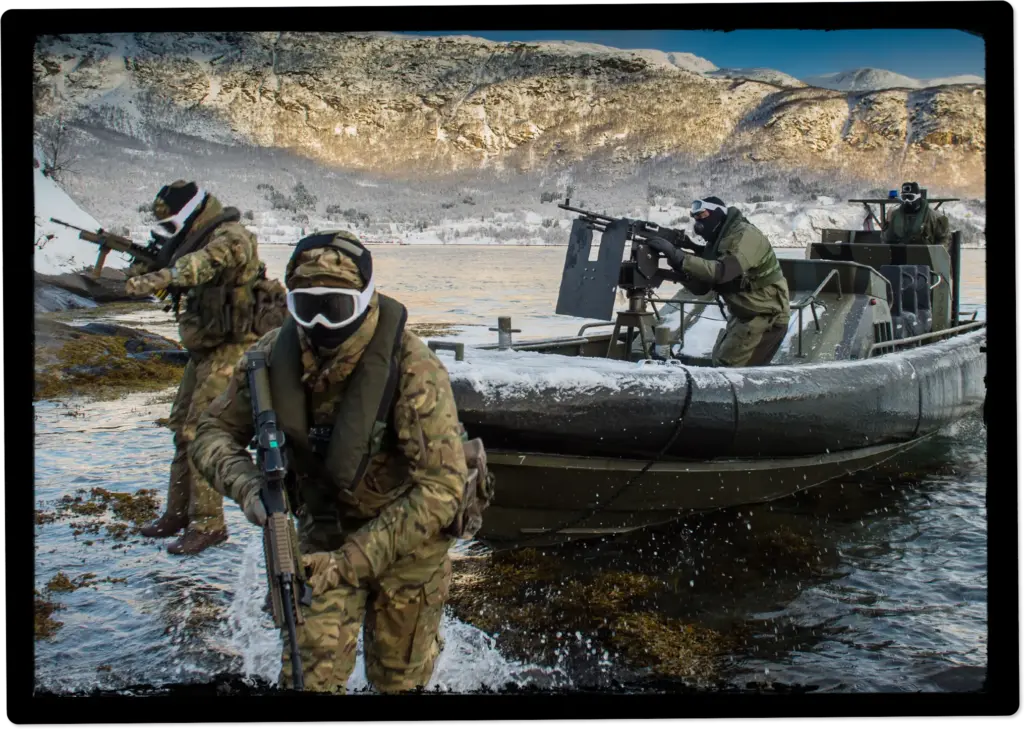
Doctrine and tactics continue to evolve to reflect the operational environment and technological development in much the same way as they had in the run–up to the Second World War and they continue to change. Whereas the 1944 norm was to assemble a vast force and to land it into a beachhead or lodgement, followed by reinforcements, reserves and supplies, the modern way is somewhat different – avoiding the ‘Iron Mountain’ and operating at range from the shore. The availability of cheaper, capable sensors and their integration into complex hard/soft kill systems means that the doctrine for the modern operator in the littoral is very different from its 1944 counterpart and today’s forces cannot adopt the same tactics as their forebears. The evolution from Ship-to-Shore movement through Over the Horizon Operations to the contemporary dispersed force approach illustrates this. However, doctrine then and now reflects the need for commanders at all levels to be able to function with robust, flexible and resilient command supported by intelligence, fires, manoeuvre and protection.
And while it is unlikely that we will see a repeat of the engineering marvel that was the Mulberry harbours off the Normandy coast, littoral operations will remain a complex and challenging logistical undertaking, not least in the areas of supply and medical support. However, without the appropriate sustainment, operations are untenable and so the full array of remote and autonomous systems is likely to be employed in pursuit of sustainment of deployed forces in the same way as in other combat functions. Thus, modern littoral warfare will be sustained in as effective a fashion as Overlord.
Conclusion
Any brief analysis of the conduct of operations in the littoral of 80+ years ago and the contemporary approach might, on the face of it, seem to yield a yawning gulf in everything from doctrine through tactics to the application of technology. However, that would be to ignore some of the fundamental principles that apply to the conduct of war. Clausewitz famously described war as the ‘continuation of politics by other means’ and that it is ‘an act of force to compel our enemy to do our will’7. Arguably, these statements remain true for today’s environment, despite the very different prevailing geo-political political situation and the development of technologies, capabilities and tactics.
An examination of littoral or amphibious operations through both the lens of the 1944 and contemporary models indicates that the central purpose of such activity remains unchanged – the aim of littoral operations is, in rough terms, the projection of military power onto a hostile or potentially hostile shore in order to achieve specific aims.
Certainly, there are technological and other developments which result in significant separation of approaches but, the paper above reveals that whilst there are indeed some profound differences, there remain key areas where the principles and practices employed are constant over the 81–year gap and putting humans in harm’s way will likely remain a central tenet of littoral operations for generations to come.
Finish
7 Clausewitz, Carl von. Vom Kriege (On War).
Berlin: Dümmlers Verlag, 1832.
Chapter 4 Picture Credits
Courtesy National Archives, NAID 176888224
UK Medical Emergency Response Team (MERT); Contains public sector information licensed under the Open Government Licence v3.0.
51 SQN; Cyprus; Pre-Deployment training; Contains public sector information licensed under the Open Government Licence v3.0.
539 Assault Squadron performing a beach assault from an Offshore Raiding Craft (ORC); Contains public sector information licensed under the Open Government Licence v3.0.
